 Intcube EPM
  Intcube Data Governance
 Resource Center
  Service & Support
  Technical Consulting



Over 300 Corporate Clients are utilizing Intcube EPM

Stay updated with industry trends and insights, and disseminate in-depth knowledge on smart enterprise management.
In the current market environment of continuously deepening digital transformation, many enterprises face a practical challenge—business scale is expanding, data volume is accumulating daily, yet the efficiency of month-end and year-end closing has failed to improve correspondingly. Procurement, production, sales, and other processes generate massive amounts of data daily, all of which ultimately need to be converted into precise figures on financial books. However, the various carry-forward operations involved in this data conversion process still rely heavily on manual completion or fragmented processing across multiple disparate systems. This model not only leads to excessive workload for finance personnel but also makes data prone to errors or delays during transmission.

In terms of trends, enterprises' demands for the timeliness of financial data are constantly increasing. As market competition changes more rapidly, financial processing workflows also need to become smoother and more efficient. It is particularly crucial to streamline the carry-forward links from the business end to the finance end, freeing finance personnel from cumbersome transactional tasks and enabling them to focus on higher-value analysis and control work.
Pain Points in Enterprise Data Carry-Forward Operations
For the finance department of any enterprise, period-end closing is an unavoidable foundational task, and it is also a meticulous job with a massive workload and lengthy processing time. From procurement and production to sales, carry-forward operations run through the entire enterprise operation process:
● In the supply chain link, the cost of material procurement needs to be carried forward as the value of raw materials;
● In the production link, accumulated manufacturing expenses need to be allocated into production costs and ultimately carried forward as finished goods inventory;
● In the sales link, the cost of goods sold needs to be transferred from finished goods inventory to the cost of main operations;
● When accounting for financial results, all revenue and expense accounts need to be carried forward to the "Current Year Profit" account to calculate the operating profit or loss for the period;
● At year-end, the balance of the "Current Year Profit" account needs to be carried forward to the "Profit Distribution" account, completing the final closure of the annual accounts;
● During the transition between the old and new year, the balances of various accounts need to be accurately carried forward as the opening data for the new year.
This series of interconnected carry-forward operations consumes a significant amount of finance personnel's time and represents a link prone to errors in manual processing. The Intcube EPM system's business form data carry-forward function is designed precisely to solve this long-standing business pain point, freeing finance personnel from tedious repetitive work.
Intcube EPM Business Form Data Carry-Forward Function
01 Standardized and Automated Processing
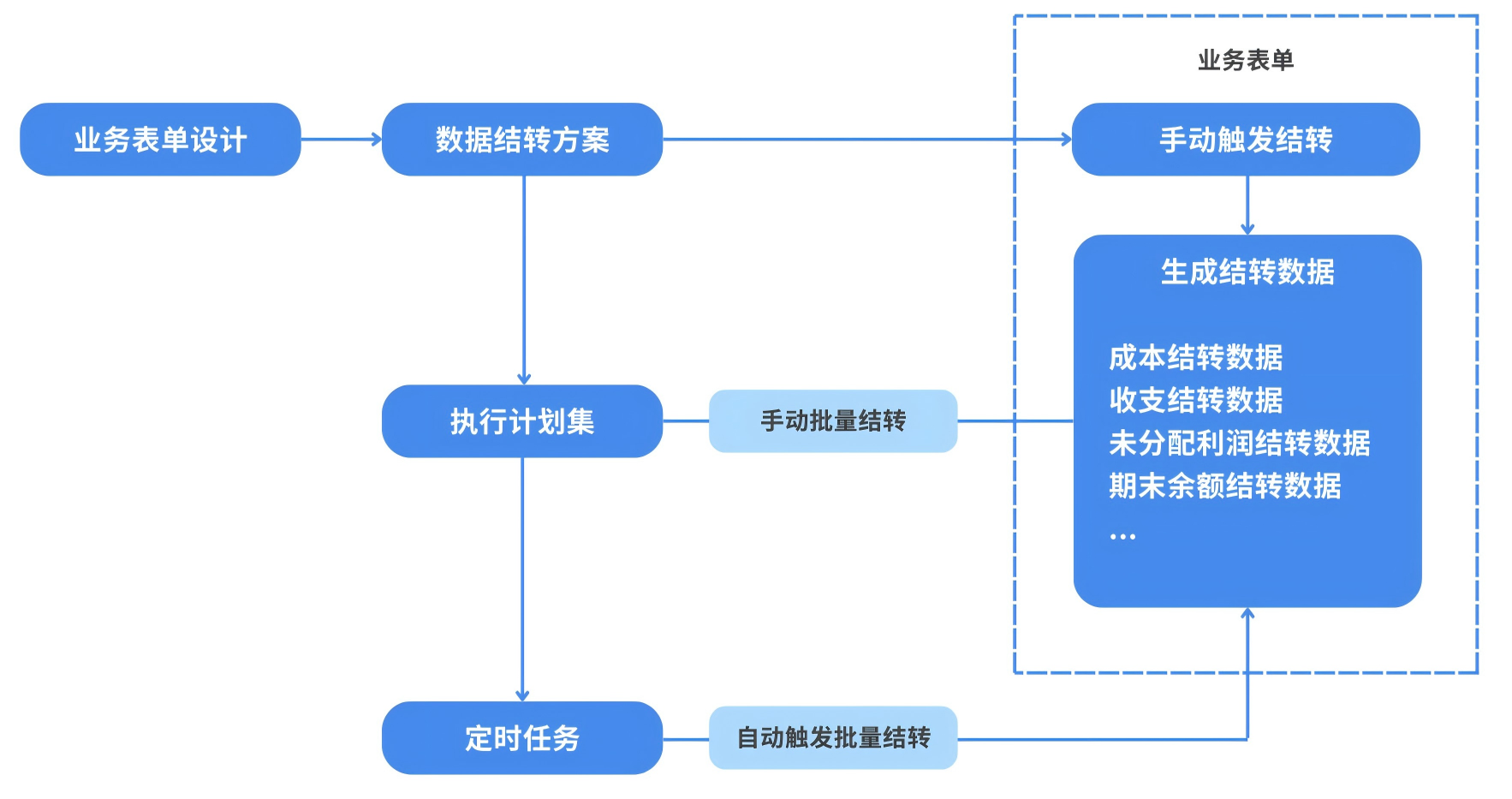
The core of this function lies in achieving the automatic carry-forward of accounting account activity amounts and balances at period-end and year-end. It does not require finance personnel to manually enter carry-forward entries based on accounting vouchers. Instead, through built-in system logic, it automatically completes the entire process from data reading and calculation to voucher generation. Specifically, this function can support the automated processing of the following types of carry-forward operations:
● Cost Carry-Forward: At month-end or the end of a production cycle, the system can automatically allocate accumulated "Manufacturing Expenses" to "Production Costs" based on standards like labor hours or output volume according to preset rules. It then carries forward the cost of completed products from "Production Costs" to "Finished Goods Inventory." When a sale occurs, the system can also automatically calculate and carry forward the "Cost of Main Operations."
● Income and Expense Carry-Forward: At the end of each accounting period, the system can automatically carry forward the balances of all profit and loss accounts, such as main operating revenue, administrative expenses, and selling expenses, to the "Current Year Profit" account, quickly generating carry-forward vouchers reflecting the period's operating results.
● Unappropriated Profit Carry-Forward: During year-end closing, the system will automatically carry forward the accumulated balance of the "Current Year Profit" for the year to the unappropriated profit account, thereby completing the full closure of the accounting year. This provides an accurate basis for preparing annual financial reports and subsequent profit distribution.
● Cross-Year, Cross-Period Balance Carry-Forward: At the beginning of a new accounting year or period, the system can automatically update the ending balance from the previous period as the opening balance for the current period, ensuring the continuity and accuracy of the ledger data.
02 Flexible Configuration to Adapt to Personalized Business Needs
In practice, different enterprises have unique business processes, cost accounting methods, and even account systems. Therefore, a "one-size-fits-all" carry-forward function cannot truly meet actual needs. This function in the Intcube EPM system supports finance personnel in customizing carry-forward schemes. During configuration, users can clearly specify the source accounts and target accounts that need to be carried forward, as well as the specific carry-forward direction. This direct configuration based on the account balance sheet level allows the carry-forward rules to closely align with the enterprise's own accounting methods. Whether using job costing or process costing to calculate costs, or having specific revenue recognition policies, precise automated carry-forward can be achieved through flexible configuration.
03 Extended Application, Covering a Wider Range of Business Scenarios
Unlike common financial software that only serves the general ledger module, the carry-forward function of the Intcube EPM system has a much broader application scope. It not only meets basic financial accounting needs but is also deeply integrated into complex business-finance integration processes such as budget management and consolidated reporting. For example, during the budget preparation phase, the carry-forward function can be used to automatically aggregate, offset, or allocate budget data submitted by various business departments according to set rules, thereby generating standardized budget reports. In the consolidated reporting process, the system can automatically complete the generation of inter-company transaction elimination entries, equity method adjustments, and foreign currency translation adjustments, quickly and accurately carrying forward the basic data submitted by subsidiaries to the group-level consolidated report data.
In summary, the Intcube EPM business form data carry-forward function aims to provide enterprises with an automated carry-forward solution that covers the entire operation process and all business scenarios. By solidifying complex carry-forward rules within the system, it achieves standardization and automation of business processes. The automation of carry-forward operations essentially builds standardized data interfaces between various links of enterprise operations, laying the foundation for more refined management analysis in the future. This function not only frees finance personnel from the intensive work of month-end and year-end closing but also opens up the final link in the transformation from business data to financial value, driving the evolution of the finance role from accounting towards analysis.
