 Intcube EPM
  Intcube Data Governance
 Resource Center
  Service & Support
  Technical Consulting



Over 300 Corporate Clients are utilizing Intcube EPM

Stay updated with industry trends and insights, and disseminate in-depth knowledge on smart enterprise management.
As enterprises increasingly demand high-quality development, the continuous application of digitalization in various financial scenarios is driving changes in corporate financial operation models and management modes. Among these, Enterprise Performance Management (EPM) systems play an increasingly critical role in supporting the execution of corporate strategies and promoting the business development of medium-sized and large enterprises.
Recently, the new-generation Intcube EPM V5.0 was released. Compared to previous versions, Intcube EPM V5.0 incorporates many new ideas in product design. By integrating technological advancements and user needs, it adopts innovative Intcube Booster as the underlying technical support, significantly enhancing EPM functionality and optimizing performance.
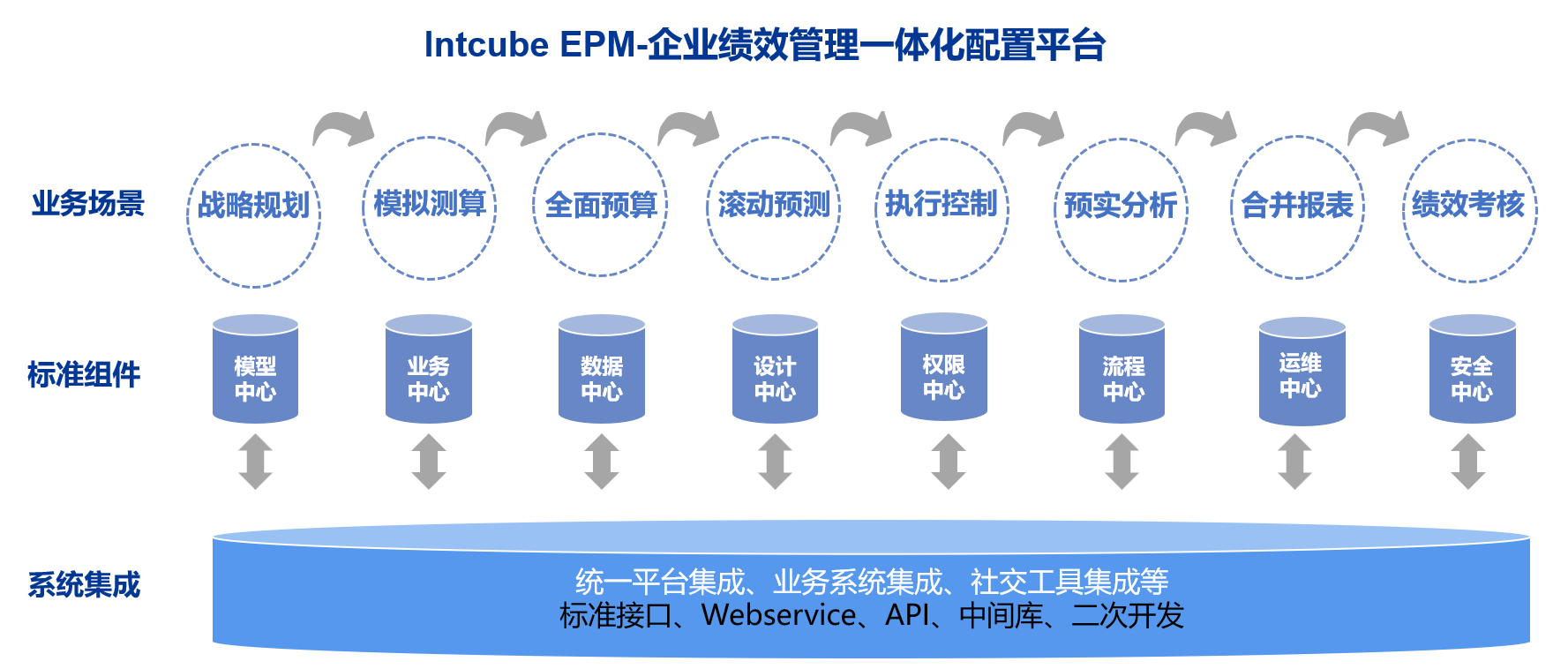
The mission of Intcube EPM is to enable enterprises to apply professional EPM systems, achieve business-finance integration and financial digital-intelligent transformation, build data governance systems, and establish efficient multi-departmental collaborative management systems. Through a unified budget management platform, it facilitates closed-loop management of comprehensive budgeting, including strategic goal setting, budget modeling, budget preparation, report consolidation, execution control, forecasting analysis, and performance appraisal. This allows enterprises to accurately and timely understand the present, predict the future based on budgeting, and truly benefit from the EPM system.
So, what specific new experience upgrades does Intcube EPM V5.0 bring?
▌ Unified Platform Management for More Efficient and Intelligent Enterprise Management
Intcube EPM V5.0 adopts a unified platform management approach, making it simpler, more user-friendly, and easier to operate compared to previous versions. It supports both on-premise deployment and SAAS cloud deployment. The new-generation EPM is based on a standard, flexible, reusable, and scalable architecture. It further layers and decouples underlying services, refines service granularity, and ensures each component is specialized and advanced. Through service standardization, collaboration, and automation, the platform's connectivity and collaborative capabilities are further enhanced. Tailored to enterprise-specific needs, it allows on-demand customization for various specialized and innovative business management requirements, transforming enterprise innovative "potential energy" into powerful development "kinetic energy." The platform's compatibility and scalability are also further improved, adapting to complex enterprise software/hardware environments and future changes.
Distributed Budget Control
Intcube EPM's Budget Control Service Center meets budget application and control requirements under distributed deployment modes. Groups and subsidiaries can deploy the EPM system separately and maintain forms and control rules that meet their own management requirements. The Budget Control Center allows setting dual control requirements, enabling automatic scheduling of control rules and automated data flow. Through the Budget Control Service Center, enterprises can establish a budget management system that flexibly combines decentralization and centralization, thereby better managing the relationship between the group and subsidiaries, clarifying their main responsibilities, and achieving overall sustained value maximization for the group company through reasonable centralization and decentralization.
Intelligent Report Consolidation
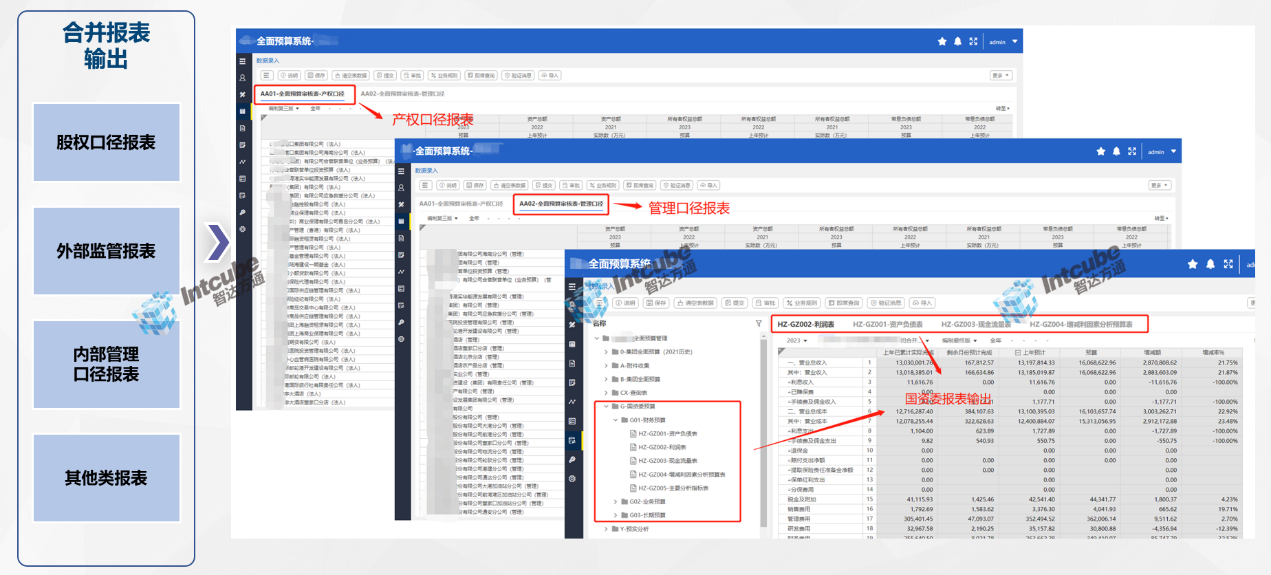
The consolidation report component has been optimized and enhanced, achieving full-process linkage from individual report data compilation and reporting, related transaction data collection, related transaction reconciliation, offset entry preparation, to generating consolidated reports. Capabilities in related transaction data management, heterogeneous data collection, cross-form data tracing, automatic reconciliation and adjustment, adjustment/offset templates, multi-currency exchange rate conversion, and consolidation calculation have been strengthened.
Multi-Perspective Report Management
Even within the same enterprise, different managers require different types, scopes, and usage methods of information based on their roles. To meet the management needs of various roles, the form component supports organizing report directories from different perspectives such as organization, project, and task, better adapting to the differentiated needs of organizational managers, project managers, task managers, and other roles, offering greater flexibility.
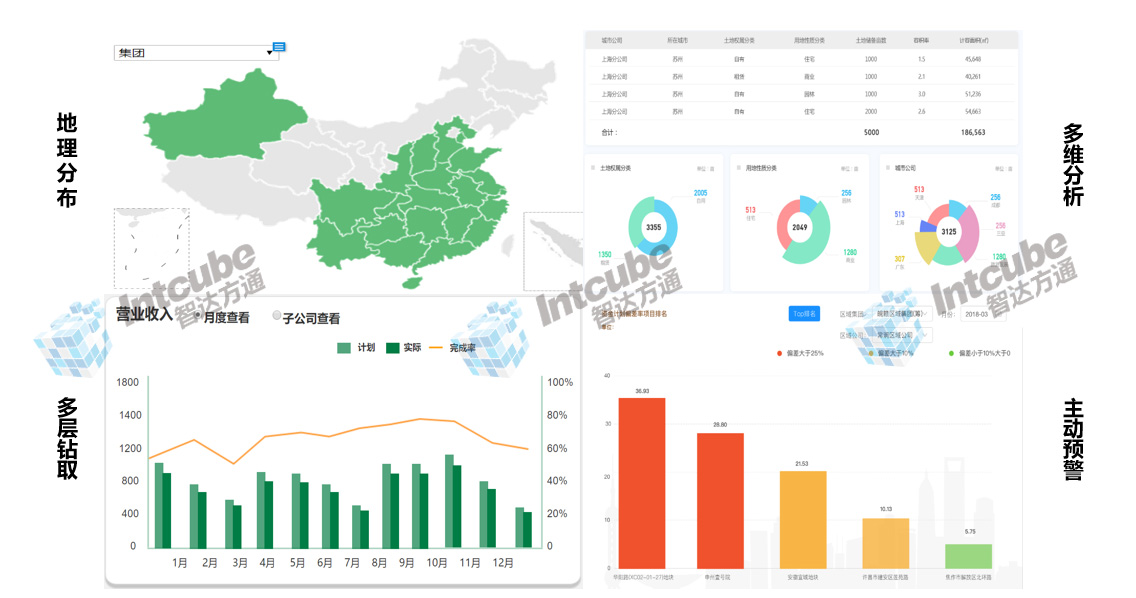
Collaborative Mobile Office Platform
The functionality of the Zhiyun APP mobile terminal has been enriched, supporting integration with third-party APP applications like DingTalk and WeChat; pending messages are sent promptly; mobile form viewing, editing, and approval are supported; and personalized configuration functions on the mobile end have been enhanced. The Intcube mobile application breaks time and space constraints, improving handling and collaboration efficiency, making enterprise management smarter and more convenient.
Office Integration Applications
In Intcube EPM V5.0, Excel/WPS plugin support for cross-platform applications on Windows and MAC is provided, optimizing operation methods. It enables querying, editing, and ad-hoc analysis from Excel/WPS multidimensional forms and business ledgers, meeting diverse user scenarios and enhancing user experience and work efficiency.
▌ Breaking Down Data Barriers, Integrating Data Governance and Multidimensional Engines into Comprehensive Budget Management
Intcube EPM V5.0 achieves all-round data asset management covering governance, storage, computation, rules, and administration. Different management modes can be applied to various categories of data such as metadata, master data, reference data, and transaction data. It supports a multi-tiered data management architecture including data lakes, data warehouses, and data marts, providing various data collection, cleaning, and processing methods. By combining management standards with technical means, data governance capabilities are strengthened.
Adoption of a New-Generation Multidimensional Database
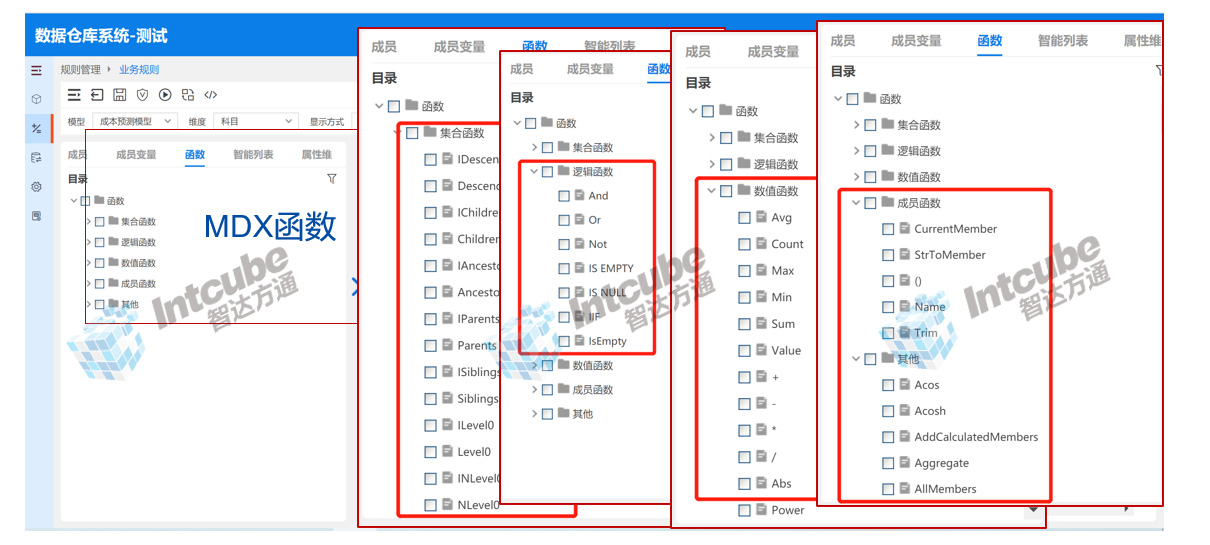
Intcube EPM is independently developed based on the new-generation multidimensional database (Intcube Booster), with core technologies being self-controllable. The system data is highly structured. Supported by an OLAP calculation engine that complies with the industrial standard MDX syntax, it enables high-speed calculation and analysis of enterprise business data, meeting user needs for real-time analysis and quick decision-making. It thoroughly resolves performance issues arising from applications like comprehensive budgeting and operational analysis on massive and complex structured multidimensional data models. Intelligent dynamic range calculation, intelligent dynamic calculation judgment, flexible dynamic calculation settings, and rich dimension attribute settings significantly enhance the calculation performance based on the multidimensional database. For massive business information stored in enterprise data warehouses, data visualization across multiple scenarios such as PC, mobile terminals, and large screens is achieved through data governance to support data-driven rapid decision-making. This truly enables quick data response from human resources to operations to financial personnel, allowing data to realize its due value.
Intcube's previous EPM system, Intcube EPM V4.5, had already adopted the new-generation multidimensional database Intcube Booster. In the newly released Intcube EPM V5.0, Intcube's multidimensional database Intcube Booster further enhances performance and expands MDX function library support. Consequently, Intcube EPM and its underlying multidimensional database Intcube Booster surpass comparable foreign products in both performance and functionality.
Full Lifecycle Management of Master Data
One-stop master data management provides multidimensional and standardized management of master data through classification, coding, description, etc., ensuring its completeness, consistency, accuracy, reliability, authority, controllability, and universality, thereby improving data quality and service collaboration capabilities. Enterprises can establish management models for master data in different domains such as organization, employee, customer, supplier, material, and account, standardize the processes for adding, changing, and reviewing master data, achieve cross-departmental collaborative management of the full lifecycle of master data, and build a true enterprise-level comprehensive key business data view.
Full Data Traceability
The platform supports the construction of linkage and traceability mechanisms between upstream and downstream businesses as well as accounts, reports, and forms, breaking down information barriers inside and outside the platform, promoting enterprise data integration. This enables enterprises to fully grasp operational data, fully utilize data value, effectively optimize resource allocation, avoid operational risks, thereby improving production efficiency, saving operational costs, and enhancing profitability.
One-Stop Interface Services
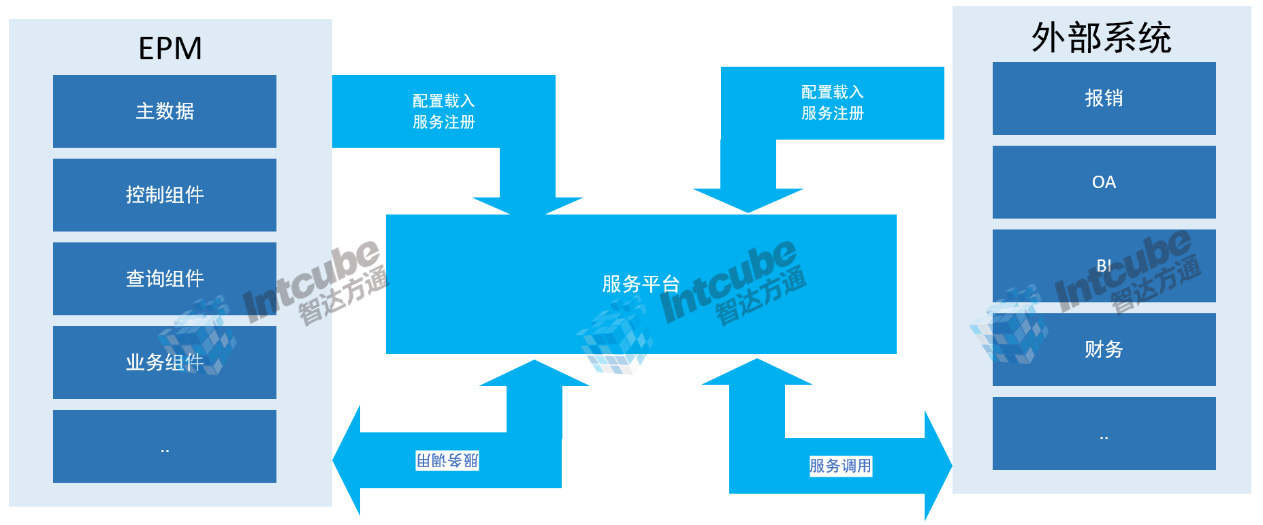
Support through one-stop interface services to connect with other third-party platforms. Authentication, authorization, coordination, scheduling, monitoring, and alerting are performed using various services provided by third-party platforms, making services configurable, manageable, monitorable, and visual. This enhances data openness and data governance capabilities, improves high availability and high concurrency support, greatly increases platform stability, scalability, and usability, promotes the utilization rate of overall enterprise resources, significantly improves cross-system information interaction and cross-departmental business coordination efficiency, and effectively prevents systemic failure risks, truly achieving the aggregation, assetization, and servitization of enterprise data.
▌ Continuous Optimization of Product Details to Enhance User Experience
In addition to improvements in functionality and reliability, Intcube EPM V5.0 has also undergone a series of optimizations and enhancements in product usability and functional operation details.
Dynamic Task Management and Control
By combining task management with process management, one-click task assignment and multi-person collaboration are achieved. Various distribution and reporting modes are supported, allowing the creation of subtasks. Tasks such as budget preparation and data reporting can be assigned to specific operational users. Online monitoring enables real-time viewing of task status and progress, strengthening the process management of target tasks, fostering initiative in implementation, and further improving work efficiency.
Personalized Portal Customization
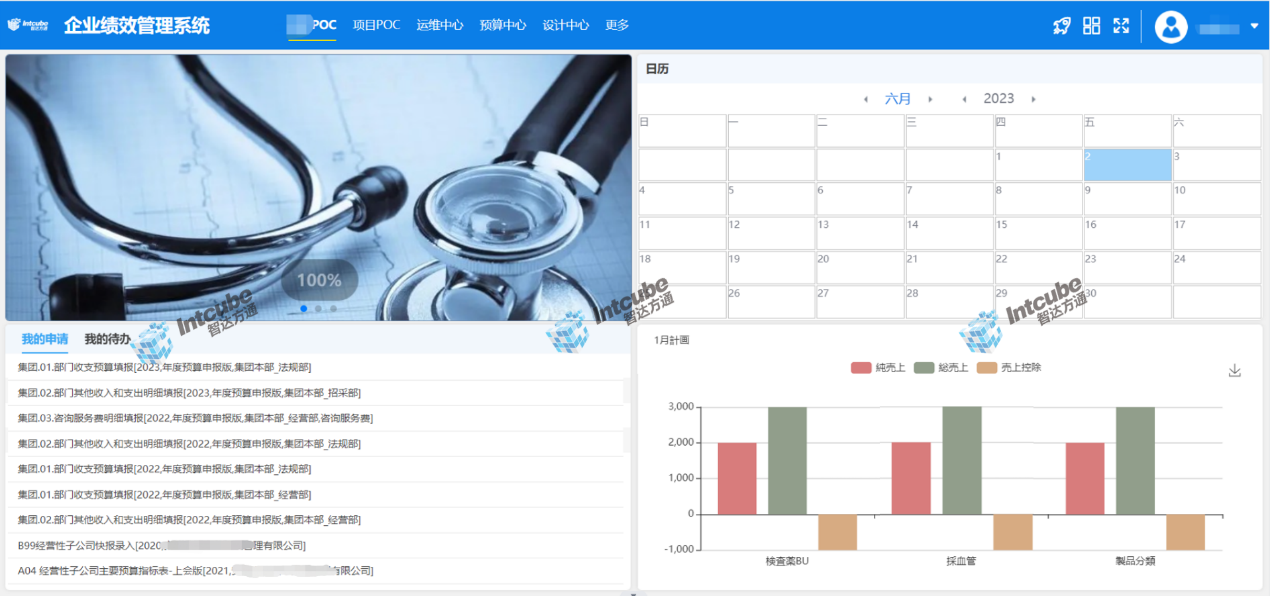
Supports centralized management of multiple applications and personalized homepage display. Various applications created on the platform can be uniformly published on the portal for one-stop login. Differentiated homepage display templates can be set to achieve personalized experiences for different users, meeting individual needs. Third-party applications can be integrated for seamless connectivity.
Practical Auxiliary Functions
Intcube EPM supports aggregation, allocation options, row, column, attribute, task filtering options, dimension cascading options, show/hide options, enable/disable options, watermark schemes, submission variables options, validation messages, print styles, ad-hoc analysis, fixed tables, floating tables, compound tables, revision tracking, member formulas, business rules, data toolbox, validation rules, drill-through schemes, form links, approval controls, data locking, and various other form auxiliary options and functions. These better meet the needs of report preparation, query, and analysis, improve form compilation efficiency, and enhance the form analysis experience.
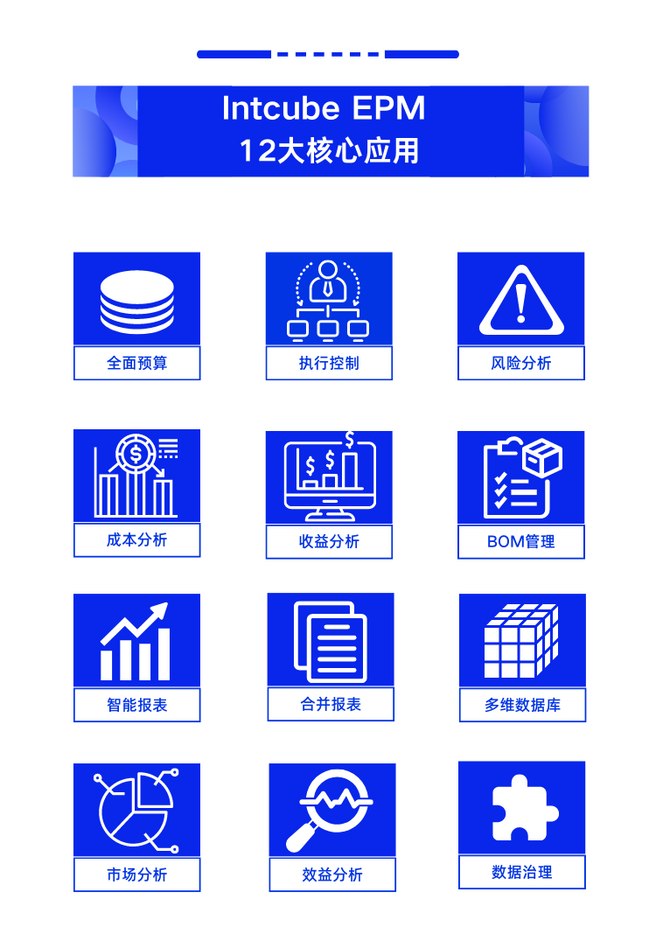
Since its establishment, Intcube has been deeply engaged in fields such as enterprise performance management, comprehensive budget management, multidimensional databases, and big data analysis, building a complete EPM product and service ecosystem. Since independently developing its first set of enterprise performance management systems in 2010, it has undergone 4 major version iterations and over 10 minor version upgrades.
The all-new Intcube EPM product represents an upgrade in experience that Intcube brings to enterprise and institutional users by integrating technology, products, and services. It adapts to various domestic and international IT technical environments, showcasing Intcube's more mature and systematic EPM ecosystem. It frees users from traditional static financial management models, upgrading to real-time data linkage based on accurate and immediate access to management data. In a more intelligent and scenario-based manner, it provides enterprises with more comprehensive and efficient digital tools for control and operation, enabling budgeting, performance, and management reports to continuously empower enterprise intelligent management.
