 Intcube EPM
  Intcube Data Governance
 Resource Center
  Service & Support
  Technical Consulting



Over 300 Corporate Clients are utilizing Intcube EPM

Stay updated with industry trends and insights, and disseminate in-depth knowledge on smart enterprise management.
In the process of shifting from scale expansion to high-quality operation and management, the role of Enterprise Performance Management (EPM) systems in Chinese enterprises has fundamentally changed. Increased external environmental uncertainty, gradual refinement of internal management, compounded by policy requirements for data security and compliance, compel the technological foundation of core enterprise operating systems to meet the top-level design requirements for independent and controllable technology (Information Innovation). At this point, EPM is no longer merely a tool for financial planning and consolidation reporting, but has become a core platform carrying group control, business-finance integration, and the balanced application of hard and soft budget execution constraints.

Looking back at the history of EPM application in China, foreign systems like Oracle Hyperion, IBM TM1, and SAP BPC, though once dominant due to their multi-dimensional database technological advantages, revealed structural deficiencies in functional design and local support when deeply integrated with the management practices of domestic enterprises. These systems lack native support for the rigid budget execution control specific to Chinese enterprises and struggle to adapt to their workflow-driven process control models. Furthermore, with R&D teams far from the local market, these systems often fall into disuse after short-term application as they cannot evolve with changing business rules. Consequently, core analytical processes in Chinese enterprises are forced to revert to Excel tools. Therefore, the domestic substitution of EPM systems has a core significance far beyond simply replacing software; it is fundamentally a system reconstruction aimed at meeting Information Innovation requirements as the baseline and achieving management upgrades as the goal.
I. Root Cause Analysis – The Generational Gap in Multi-dimensional Database Technology and the Core Hurdle for Domestic EPM
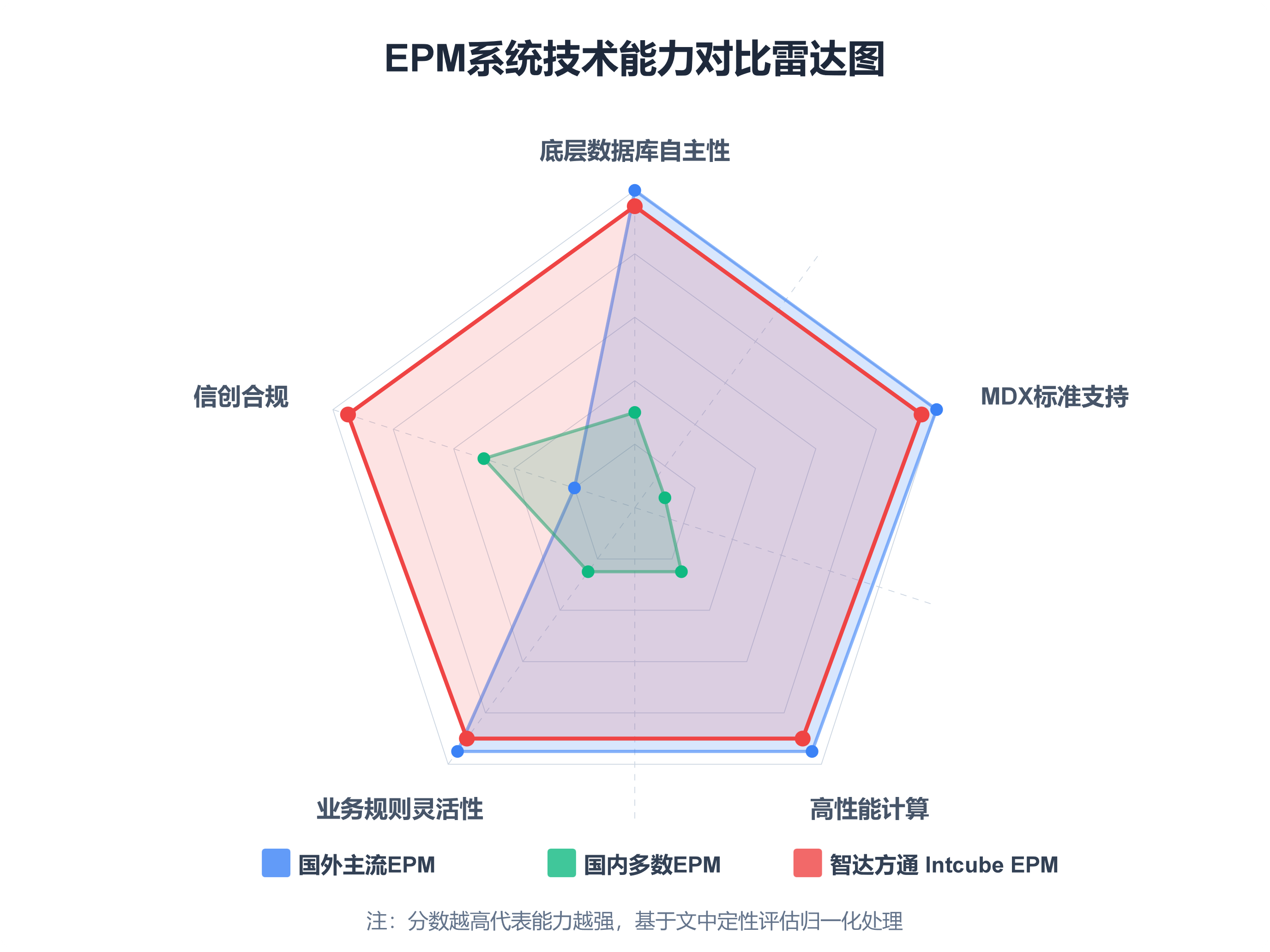
The core processing objects of an EPM system are an enterprise's multi-dimensional business and financial data, covering dimensions such as product, region, department, and account. Unlike the relational database model based on "tables", the multi-dimensional database adopts a "data cube" model, achieving millisecond responses for complex allocations, recursive calculations, and "what-if" analyses through pre-calculation. This determines that the performance ceiling and model flexibility of an EPM system are essentially defined by the multi-dimensional database engine it relies on. Internationally, MDX (Multi-Dimensional eXpressions), the industry-standard query language for accessing and analyzing multi-dimensional data, holds importance equivalent to SQL for relational databases.
Currently, the technical route of most domestic EPM software vendors primarily involves simulating multi-dimensional calculations based on relational databases or encapsulating foreign open-source multi-dimensional data engines. Because their underlying engines do not support the MDX industry standard, these systems cannot efficiently complete the modeling and management of complex business rules through standard interfaces. In contrast, mainstream foreign EPM systems (such as Oracle Hyperion Essbase and IBM TM1) are built on independently controlled multi-dimensional databases and deeply support MDX. In comparison, Intcube's core R&D team originated from the North American core R&D team of the former Hyperion multi-dimensional database and EPM system, possessing over 25 years of technical accumulation. Its launch of the country's first original independently developed multi-dimensional database product, Intcube Booster, makes it one of the few domestic engines that supports the MDX industrial standard at the underlying level, constituting the technological prerequisite for Intcube to achieve domestic EPM substitution.
II. Application Difficulties – Structural Disconnect Between Localised Management Logic and Foreign Systems
Technical performance is not the sole, nor even the primary, determining factor for long-term enterprise use of an EPM system. From an application perspective, the "cultural inadaptability" of foreign EPM systems in Chinese enterprise environments often stems from three major structural disconnects at the business logic level:
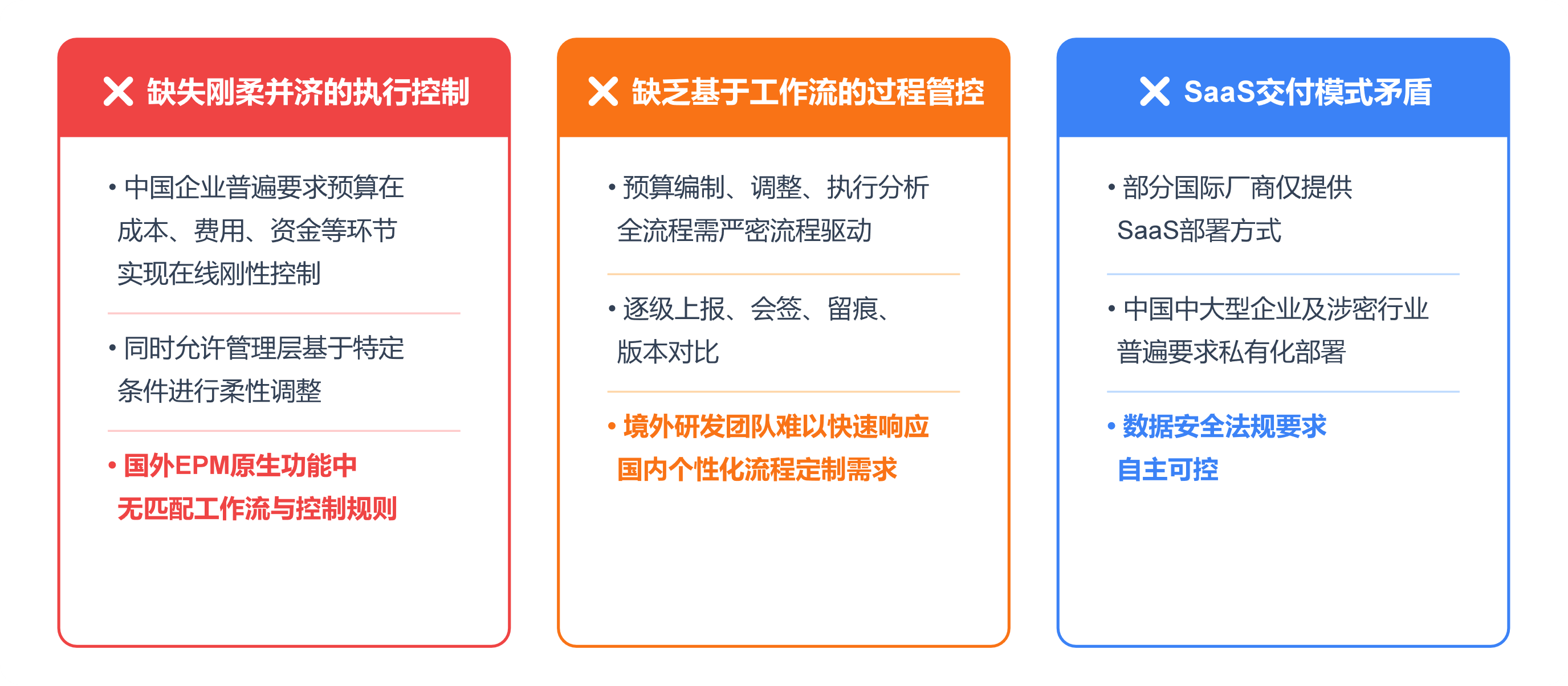
These factors collectively create a common dilemma: after paying high procurement and implementation costs, enterprises find the system gradually discontinued within a few years because it cannot adjust models and rules according to changes in business management, ultimately forcing operational analysis back to fragmented Excel work. Therefore, replacing foreign EPM systems is not a mere technology upgrade; it requires a solution that can retain the advantages of the original technical architecture while natively supporting Chinese-style process control logic.
III. Intcube Solution – One-Click Migration to a Management-Enhanced Domestic EPM Alternative
Addressing the fundamental technical thresholds and application pain points mentioned above, Intcube provides a domestic EPM substitution path centered on its independent multi-dimensional database + one-click migration tool + localised management components.
(I) Core Foundation: Independent Multi-dimensional Database Intcube Booster
The cornerstone of the Intcube product solution is a multi-dimensional database built on JavaEE technology, fully self-developed by the core team, independent of any third-party databases or open-source frameworks. The platform supports multi-dimensional modeling, dimension outline management, aggregation calculations, and MDX business rule parsing. It incorporates intelligent dynamic calculation optimization technology to effectively improve query performance. Its distributed storage architecture meets massive data processing requirements while supporting cross-model data linkage and flexible analysis. Additionally, the platform features a no-code configuration interface, helping achieve sub-second responses for business scenarios like comprehensive budgeting and operational analysis.
(II) Migration Bridge: One-Click System Migration Function

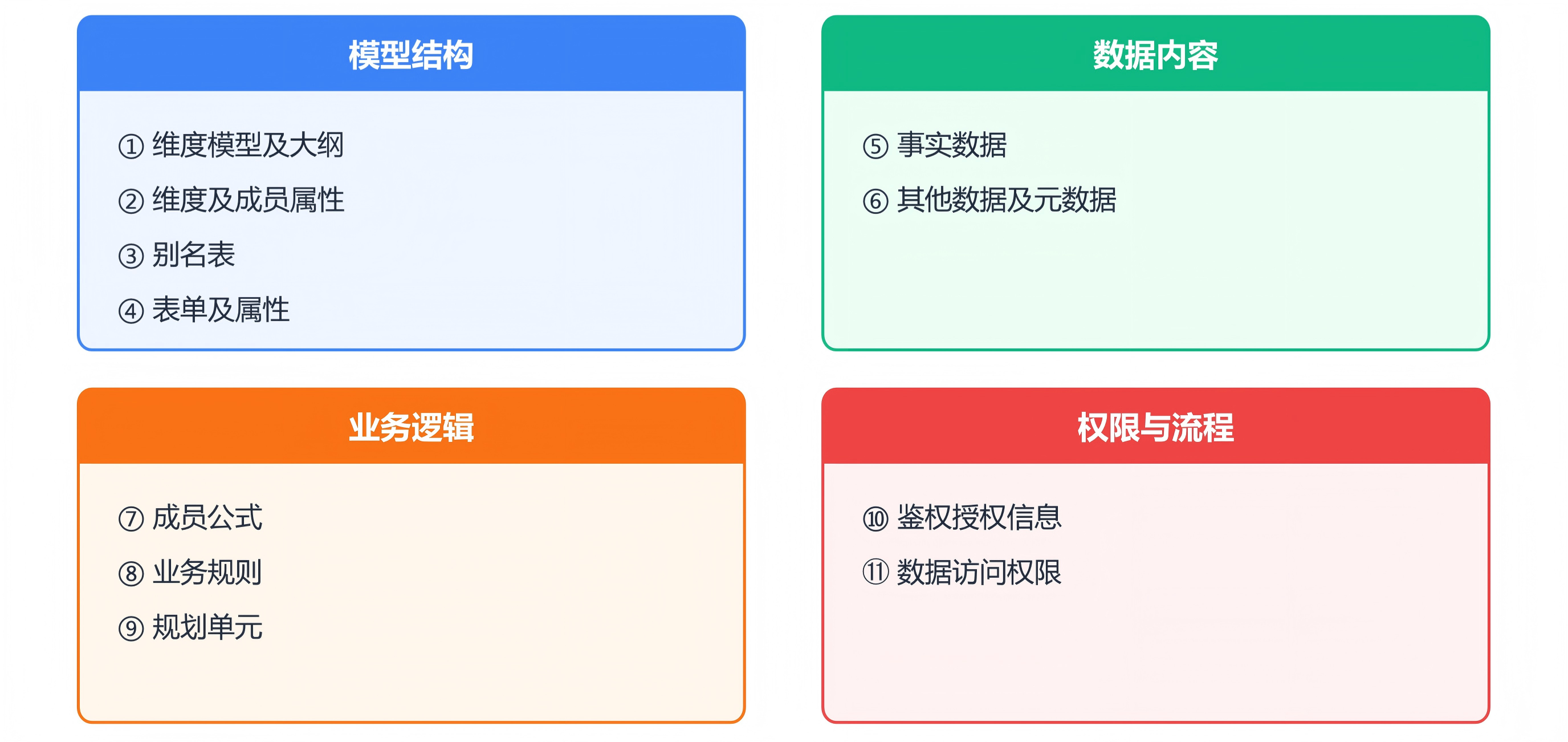
To reduce system replacement risks and migration costs, the Intcube EPM system is equipped with a one-click migration function. This function can migrate multi-dimensional database models (including dimensions, members, aliases, and attributes), historical data, business calculation rules, and even the metadata of application components from foreign systems like Oracle Hyperion to the Intcube platform as a whole.
By integrating with the Hyperion APS API interface service, it enables one-click migration of the following artifacts:
Based on practical project experience, the migration follows a phased, rollbackable strategy: first, migrate test environment data for validation, then proceed to production environment migration. Migrate after a full backup to ensure the latest data at the time of switchover. After migration, data consistency is ensured through methods such as record count comparison, key field validation, sample business verification, and full-data reconciliation.
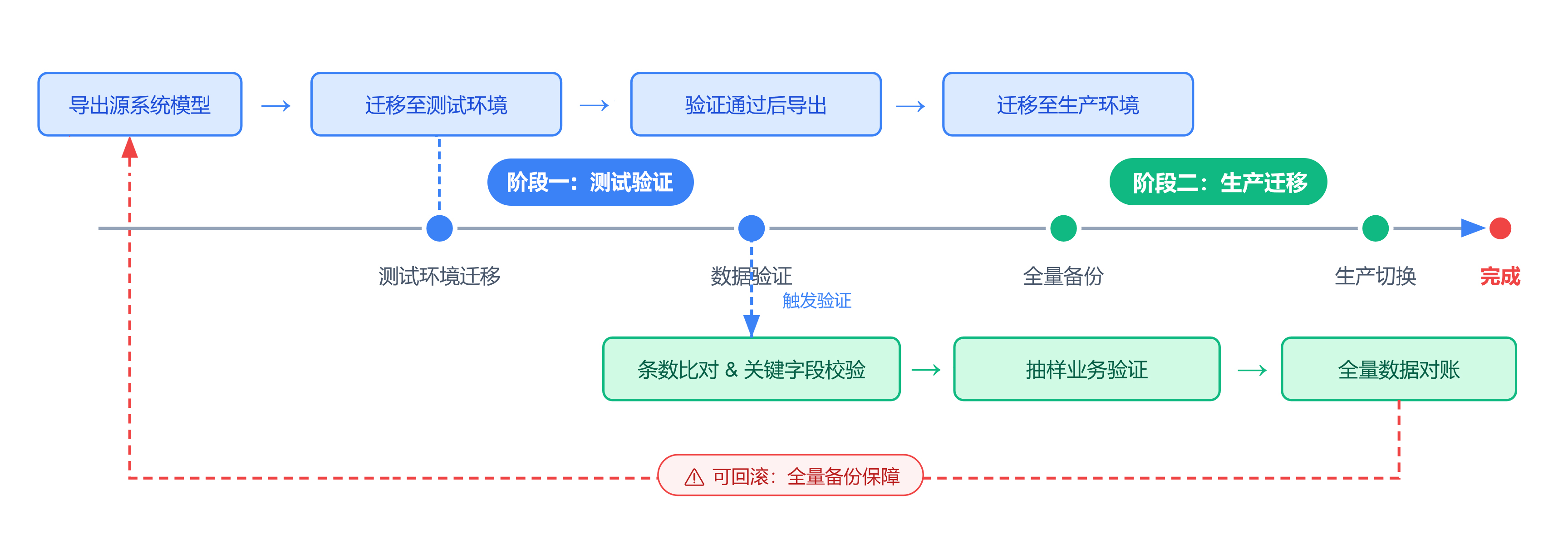
Two-Phase Flowchart for Migration and Verification
(III) Management Enhancement: Functional Components Adapted to the Control Logic of Chinese Enterprises
Built upon the architectural advantages of the original EPM platform, the Intcube solution adds localised management modules not natively present in foreign software. This achieves a generational leap in management capability from the architectural level, rather than just a simple replacement.
1. Platform Architecture Restructuring
Unified Portal and Module Consolidation: Establish a new platform-based unified management architecture supporting business modules such as master data management, multi-dimensional database, budget preparation, execution control, performance evaluation, and consolidated reporting, achieving unified portal, permissions, processes, and data views.
Refined Service Granularity: Decouple underlying services, making the architecture standardized, flexible, reusable, and scalable to cover more business scenarios.
Comprehensive Data Asset Management: Covers the entire data lifecycle ("manage, store, compute, regulate, govern"), supports classification management of metadata, master data, transaction data, etc., adapting to multi-layered architectures of data lakes, data warehouses, and data marts.
2. Functional Extensions and Optimizations
Tailored to the actual control needs of Chinese enterprises, the following core functions have been specially optimized:
● Master Data Version Management: Adapts to changes in different periods and business scenarios, allowing iterative upgrades based on enterprise management strategy, achieving standardized and unified management of master data.
● Task Reporting and Reminders: Fully extended and optimized functions for task reporting, near/due/overdue reminders, etc.
● Dynamic Loading of Multi-Dimensional Forms: Optimized dynamic loading and pagination mechanisms for multi-dimensional forms, improving user experience with large data volumes.
● Built-in Calculation Solution Engine: System includes a built-in calculation solution engine, supporting online editing and use of stored procedures to meet complex business calculation needs.
3. Budget Execution Control and Process Management
Achieves a leap from post-event analysis to in-process control in the budget execution phase:
● Embedding Control Rules into Business Processes: Integrates with business systems such as financial shared services and procurement contracts. The budget control service center receives business documents, checks budget balances in real-time, and returns occupancy or confirmation results, achieving online rigid control of budget execution.
● Cross-System Data Linkage: Completes interface adaptation with financial shared service platforms, ERP, performance appraisal systems, etc., building standardized data channels for real-time budget data synchronization and tight business process linkage.
IV. Practical Verification – Hyperion Replacement Case Study in a Large Enterprise
The domestic substitution solution of the Intcube EPM system has been validated through application in several large central and state-owned enterprises. Typical cases include:
SDIC Xinjiang Luobupo Potassium Salt Co., Ltd.
(Comprehensive Budget Management Information System Upgrade and Optimization Project, Data Warehouse System Implementation Project)
China Banknote Design and Plate Making Co., Ltd.
(Planning and Budget Management, Expense Control System Project)
These enterprises have successfully achieved a smooth transition from the Oracle Hyperion system using the one-click migration function of Intcube EPM. The core outcomes of the migration are:
● Business Continuity Assurance: The migration was completed within the scheduled window. End-user daily operations such as budget preparation, financial consolidation, and operational analysis were not significantly impacted.
● Complete Preservation of Historical Assets: Original historical data and complex business rules (allocation, elimination, translation) were fully inherited and continued to function correctly after migration.
● Significant Management Capability Enhancement: The new system supports budget execution control functions deeply integrated with the internal business processes of SDIC Group, effectively compensating for the shortcomings of the original system.
This substitution not only met the SDIC Group's requirements for Information Innovation compliance but also simultaneously achieved a management capability upgrade, serving as a reference case of significant value. Beyond these cases, Intcube's domestic substitution solution has been successfully implemented across multiple industries, including healthcare, energy, ports, and machinery manufacturing.
The ultimate goal of domestic EPM system substitution should not be limited to finding a replacement product compliant with Information Innovation requirements. Instead, enterprises should leverage the system replacement opportunity to upgrade their operational analysis system, often disconnected from business, into a long-term management platform that aligns with the control logic of Chinese enterprises and supports pre-event/in-process control and business-finance integration. The simplified control functions behind the standardised products offered by international vendors have an unbridgeable gap with the dynamic, refined, and process-emphasizing needs of Chinese enterprises. Relying on its self-developed multi-dimensional database and one-click migration capability, Intcube not only ensures business continuity but also embeds Chinese-style process control capabilities within its product system, enabling the system to truly integrate into enterprises' daily operational decisions and achieve intelligent dynamic management and decision-making for enterprises.
